
Field Notes
an inside look at the science and stories behind CSLI
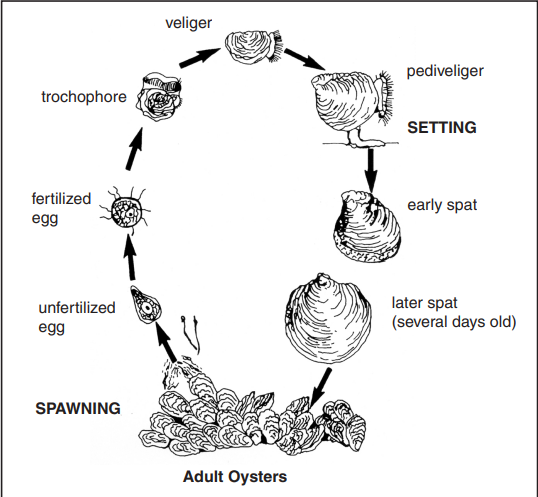
The Life Cycle of the Eastern Oyster
The Eastern oyster, Crassostrea virginica, begins its reproductive cycle in late spring
and continues through early fall. An increase in temperature and salinity act as cues for
Eastern oysters to begin spawning. During spawning, Eastern oysters synchronize the
release of sperm and eggs, with females releasing over 100 million eggs during each
reproductive season. Once the gametes are released, the sperm and the egg meet and
fertilization occurs in the water column. Upon fertilization, the larvae develop into trochophore, a pear-shaped microscopic larva that has a distinctive band of cilia, hair-
like structures that are present on a variety of cell surfaces. The band of cilia allows the larva to control their swimming while drifting out in open water.
After 24 hours, the trochophores progress to the veliger stage, where they form their
shells and an organ called a velum. The velum, which is formed from the ciliary band
from the trochophore stage, is an important organ that allows the larvae to feed on small
plankton and swim. Within a couple of weeks the larva transitions into the pediveliger
stage, which is defined by the development of eye spots and the foot. This muscular
foot allows the larva to abandon their open water lifestyle and begin settling to various
surfaces. At this stage the larva will search for shells, rocks, oysters, and other surfaces
to attach themselves to. Once finding a suitable home, the larva will cement themselves
to the surface, and transition to the spat stage. Spat are small juvenile oysters that
mature into adult oysters between one to three years.
Once an adult, the reproductive cycle begins again with the adult Eastern oyster
spawning and producing the future generations. Although Eastern oysters make a large
effort during spawning, only around 1% of the fertilized eggs become adults. Because
of these low survival rates, it’s extremely important to restore oyster populations that
have been historically declining. Through our shellfish restoration program, we have
increased Eastern oyster populations by growing oysters and releasing them to our
harbors. By continuing this program we are restoring Eastern oyster populations and
aiding in the recovery of our coastal marine ecosystems.
Sources
Kennedy, V. S., Newell, R. I. E., & Eble, A. F. (1996). The eastern oyster: Crassostrea virginica. Maryland Sea Grant College; NOAA Institutional Repository. https://repository.library.noaa.gov/view/noaa/45763
Texas Parks and Wildlife Department. (n.d.). Eastern oyster (Crassostrea virginica). https://tpwd.texas.gov/huntwild/wild/species/easternoyster/
Wallace, R. K. (2001, August). Cultivating the eastern oyster, Crassostrea virginica (SRAC Publication No. 432). Southern Regional Aquaculture Center. https://srac.msstate.edu/pdfs/Fact%20Sheets/432%20Cultivating%20the%20Eastern%20Oyster,%20Crassostrea%20virginica.pdf